
Digital Literacy in Early Years: It’s About Pedagogy, Not Screens
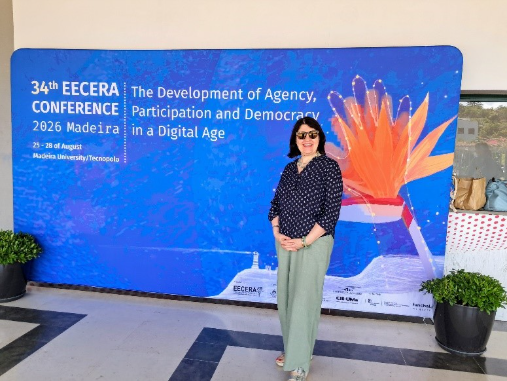
Even in a digital age, nobody goes to a good conference without a notebook. I spent three days at the 34th EECERA Conference at the University of Madeira…
September 16th 2026
We spend a great deal of time in Early Years thinking about what children eat, what they drink, how much they move and whether they spend enough time outdoors. But how often do we stop and ask a much more basic question: What are they breathing?
That was the question running through our latest Actions for Sustainability Community of Practice podcast, and I confess, it left me looking rather differently at the apparently innocent air around me.
Our guests, Louise Thomas from Air Aware Labs and Hannah Jackson from Clean Air Aware, took us into the largely invisible world of indoor and outdoor air pollution. And invisible is the problem. We notice rubbish. We notice traffic. We notice a dirty room. We don’t necessarily notice poor air.
Yet children are particularly vulnerable to air pollution. They are developing rapidly, they breathe more frequently than adults and, rather inconveniently, they are also closer to the height of vehicle exhausts.
There were some fascinating practical nuggets. Taking a quieter backstreet rather than a main road can reduce a child’s exposure to pollution. Even where you walk on a wide pavement can matter. And one of the more counter-intuitive points was that sitting inside a car doesn’t necessarily protect you from pollution. Exposure can actually be higher inside the vehicle.
This made me think about how much of children’s exposure to air pollution is connected to the everyday journeys we make to and from nursery, school, home and other places.
Then we went indoors.
Indoor air quality in nurseries and Early Years settings matters, too. Ventilation matters, but simply flinging every window open all winter isn’t necessarily the clever answer either.
Understanding and monitoring air quality allows settings to ventilate when needed, use filtration intelligently and balance children’s health with energy use. That is exactly what becoming sustainability-informed means to me: understanding the connections rather than simply following a list of supposedly green behaviours.
And then came the candles.
Apparently our lovely, scented candles, air fresheners, cleaning sprays and other products that make a room smell reassuringly “clean” may themselves contribute pollutants to indoor air.
I was so surprised by that fact! Of course, now once you know something, as Hannah said, you can’t unknow it.
The most hopeful part of the conversation was the research discussed on London’s cleaner air.
Louise described recent findings suggesting that when children’s exposure to pollution was reduced, their lung development could begin to recover. That shifts the conversation from simply preventing future harm to understanding that action now can make a difference to children now.
It is a powerful reminder that conversations about air pollution and child health are not simply about a distant environmental problem. The decisions we make about the air around children today matter.
For Early Years settings, this isn’t a reason to keep children indoors. Quite the opposite.
The benefits of being outside, moving, exploring nature, talking, playing and learning remain hugely important. The challenge is to help children experience the outdoors in the healthiest way possible: greener routes, quieter streets, less idling traffic, more planting and a better understanding of the air around us.
There are also simple things settings can consider when thinking about clean air for children:
None of these things needs to happen overnight. The important thing is to start understanding the air around us and make informed decisions.
My favourite message from the conversation was also the simplest: Start where you are.
Look at the journey to nursery. Look at the traffic outside your gate. Look at ventilation. Look at cleaning products. Talk to parents. Measure what you can. Learn something and then act on it.
Sustainability can sometimes feel enormous, because it is. But becoming sustainability-informed isn’t about knowing everything before we begin. It is about noticing more, understanding more and using that knowledge to make better decisions.
As I often say, the more you know, the less you know.
This podcast certainly proved that. Although I do now know one thing: nobody needs to buy me another scented candle.
Listen to the latest Actions for Sustainability podcast and find out what you, your nursery and your families can do to breathe a little easier.
Even in a digital age, nobody goes to a good conference without a notebook. I spent three days at the 34th EECERA Conference at the University of Madeira…
One of the great pleasures of our Action for Sustainability Community of Practice is that it brings together educators, researchers and leaders from across the world who are asking…

Why listen to this episode? Hear directly from Professor Barbara Rogoff on sociocultural learning and how children learn through participation Explore why culture and…